
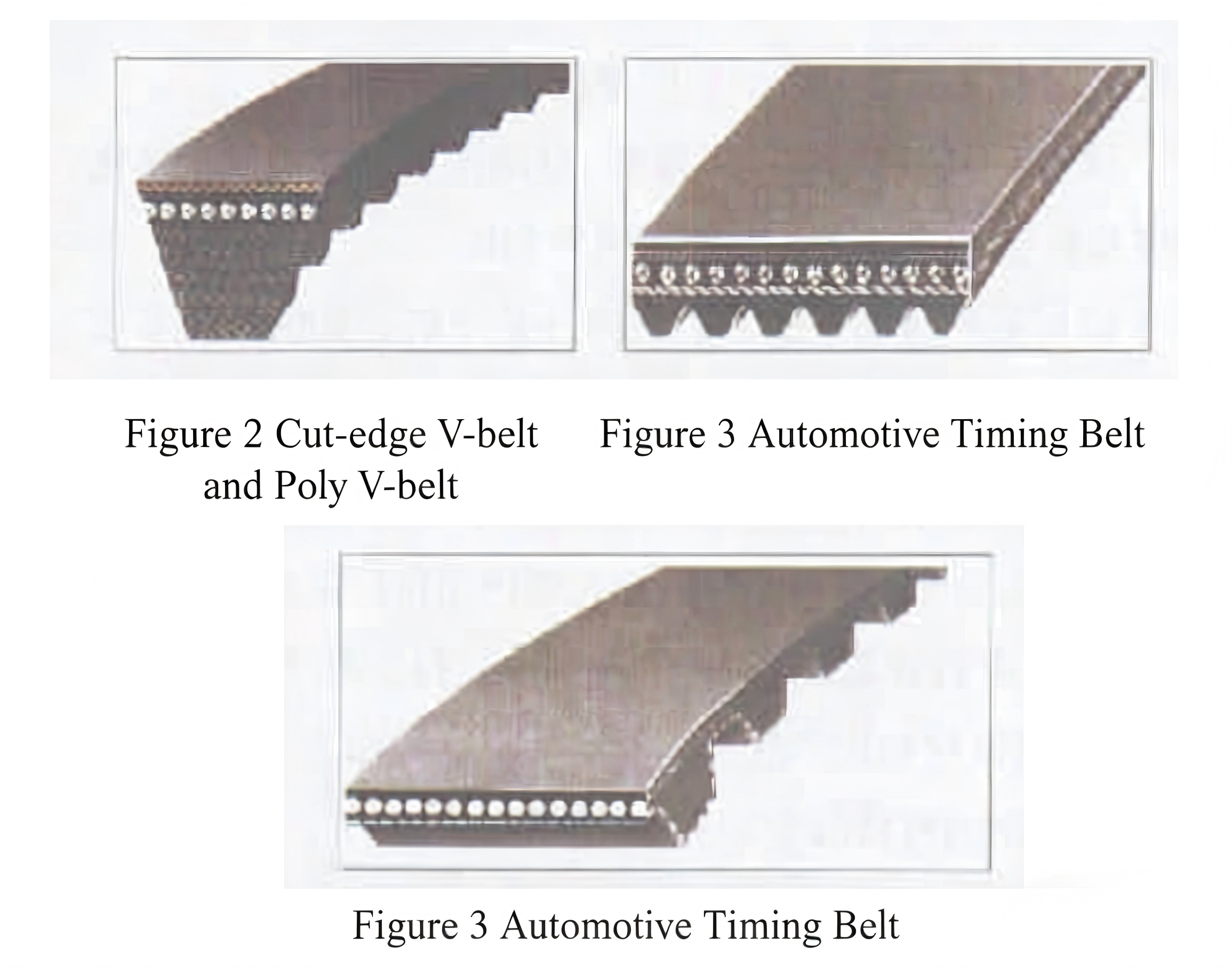
The fastest growing types of transmission belts in the recent years have been cut-edge V-belts, multi-ribbed belts (Figure 2) and synchronous belts (Figure 3). The cut-edge V-belts have better transmission efficiency, high power transmission capacity, long service life, and high energy savings compared to wrapped V-belts. In addition to having the benefits of edge cutting V-belts, multi-ribbed belts also have the flexibility of flat belts, high speed ratios, and high speed capabilities. Synchronous belt drives are a combination of belt drives, chain drives and gear drives. As a result these belts are finding an ever growing number of applications and this is a trend that will be followed in the future in the development of transmission belts.
Production processes and manufacturing equipment of the state-of-the-art V-belts, multi-ribbed belts, and synchronous belts are fundamentally similar, and the only difference is in some specific procedures and further processing stages. The manufacturing involves the process of components (sheet extrusion, splicing of short fiber-loaded sheets, sewing nylon elastic fabric, fabric cutting), assembly, vulcanization, grinding, cutting, and quality checks (appearance, dimensions, performance).
2.1 Building
Single-drum building machines normally construct cut-edge V-belts, multi-ribbed belts, and synchronous belts. In order to remove the twist effect of the tensile cord in synchronous belts, two separate tensioning systems are required to lay cords of different twist directions (i.e. "S" and "Z" twists) simultaneously. Several Chinese manufacturers in the early years imported building machines of the SCHOLZ company in Germany. They tended to bring in multi-purpose building machines (universal machines) because of the investment factors at that period. These machines are applicable in the construction of wrapped V-belts, cut-edge V-belts, multi-ribbed belts, and synchronous belts as well as in cutting protective sleeves, back-side grinding of synchronous belts, and cut-edge V-belts and synchronous belts. The machine has a main drive, building drum, cutting drum, cutting unit, grinding unit, tailstock, four-station (strip) let-off, cord laying unit, two-station cord let-off, and electrical control system.
Through integrating or differentiating some functions of the multi-functional V-belt building machine, specialized equipment has been created, including grinding/cutting machines that have cutting and back-grinding functions, and single-function building machines, cutting machines, and back-grinding machines. These machines are structurally the same, basically they hold the functional components necessary and scrap the unneeded ones off the multi-functional V-belt building machine.
In China, Qingdao Yilida Company is not the only company that has taken and successfully fulfilled the national project of science and technology known as the Ninth Five-Year Plan, but other manufacturers also manufacture high-technology V-belt, multi-ribbed belt, and synchronous belt building machines. They have quite similar operating principles and their products are simple or sophisticated in nature depending on the level of user requirements.
2.2 Vulcanization
Cut-edge V-belts, synchronous belts and multi-ribbed belts are vulcanized in the same manner as wrapped V-belts using vulcanizing autoclaves, and all can be vulcanized in vertical rubber-sleeve vulcanizing autoclaves. According to the pressurization approach, there are two types of rubber-sleeve autoclaves: steam heating and pressurization, and steam heating with water pressurization. At the present, both imported autoclaves and home-made DLT autoclaves are of the steam heating and pressurization type. They utilize PLD (Proportional, Integral, Derivative) control, provide high temperature control accuracy, and high production efficiency, and high product quality, but need a medium or high-pressure steam boiler.
2.3 Cut-edge V-belt Cutting
2.3.1 Single-drum Cutting
In single-drum cutting, a single-drum cutting machine, including the multi-functional V-belt building machine described above, is used. A protective cutting sleeve should be cut beforehand on an expanding drum and ground round. The sleeve was cut into separate cut-edge V-belts by two circular disc knives. The belt cross-section is homogeneous, and the manufacturing capacity is great. But the cost of the growing drum is heavy and the work of the protective sleeve is laborious and time-consuming.
2.3.2 Double-drum Cutting
In double-drum cutting, a double-drum cutting machine is used to cut the vulcanized belt sleeve into individual belts based on width and angle standards. This was initially invented by Berstorff in Germany. A number of Chinese factories like in Shanghai and Kaifeng have been importing such machines sequentially in Germany. This kind of equipment has been developed by domestic firms such as Qingdao Yilida, Qingdao Moson and Shaoxing Junma. The double-drum cutting machine is made up of a main drive, cutting drum, tensioning drum, cutting device and control system. The belts of the inner circumference of 680 to 3000 mm can be cut by controlling the distance between the tensioning drum and the cutting drum. The double-drum cutting machine does not require an expanding drum and a protective cutting sleeve, which leads to less investment in equipment. Nevertheless, it has less cutting precision and the cut belts need to be length measured and ground.
2.4 Multi-ribbed Belt Grinding
The vulcanized multi-ribbed belt sleeve is shaped into the ribbed surface by using the multi-ribbed belt grinding machine. The machines may be categorized as single-belt multi-ribbed belt grinding machine and whole-sleeve multi-ribbed belt grinding machine depending on the mode of processing.
2.4.1 Single-belt Multi-ribbed Belt Grinding
The single-belt multi-ribbed belt grinding machine is a machine that is composed of a grinding unit, drive pulley, tension pulley and electric control system. The belt blank is cut to the necessary width, and is slipped around the drive pulley, and tensioned by the tension pulley, and the belt is ground by the high-speed rotation of a specially profiled grinding wheel. The machine can be used to grind the ribs of PJ, PK, and PL multi-ribbed belts with the belt circumference of 600-2500 mm and the width of less than 30 mm, at a grinding linear speed of 30 m/s.
2.4.2 Whole-sleeve Multi-ribbed Belt Grinding
The principle of the whole-sleeve multi-ribbed belt grinding machine is as follows: The vulcanized belt sleeve along with its mold is attached to the main shaft of the grinding machine and turns with it. When one section has been ground, the grinding unit is moved transversely to a specific distance to proceed with grinding the next section until the whole belt sleeve has been ground. The multi-ribbed belt grinding machine is a whole sleeve machine that is more efficient in production and has more dimensional accuracy in its products than the single-belt machine. It however needs more accuracy in equipment, molds and control systems and therefore more equipment is invested. This machine can also be used to grind the back of synchronous belts.
3. Inspection
The overall transmission belt inspection includes the aspect of outside appearance(cross-section size, length), property of physics and mechanics, dynamic performance (transmission power and fatigue life).
3.1 Length Measurement
Since China's reform and opening, China's transmission belt standards have been revised and drawn successively in the aspect of international and European/American standards. The length of transmission belts are regulated on datum system and effective system rather than inner circumference system as China had for several decades. Therefore, specialized length testing equipment are needed. As the mid-1980s, Automotive V-belt length testing machine was designed by Shanghai Aircraft Design and Research Institute to meet the formulation of standard for automotive V-belt dimensions. The V-belt length testing machine has become a required equipment for manufacturers when the new standard for V-belt come into effect in China.
Synchronous belt length testing machines require more precise performance and usually adopt relative measuring method. Wuxi Rubber Factory had imported a synchronous belt length testing machine from SCHOLZ in Germany. SEU and QINGDAO MOSON also design such testing machines.
3.2 Fatigue Life
Fatigue life testing can be classified into the methods without torque and with torque, former is known as flex tester. A non-torque tester has been developed to adapt to the new standard for V-belt in China(GB1174-96). During the test, the belt transmits no power, its inner and outer sides relative to the pulley do not slip, its within tension will not change with rotation of the pulley. The test can simulate only the flexing of the belt when run over a pulley, count the no. Of flexing and measured elongation. This test typically requires 5 to 7 days to finish, or speed up the rate of wear by reducing the size of the pulley or initial tension. This method has low correlation to practical condition of transmission belt operation. It is more suitable to quality control.
The methods with torque can make a comprehensive and relatively accurate determination on the quality of transmission belt in a short period of time. Foreign made automotive V-belt fatigue life test machines are imported to China by Guiyang, Wuxi and Kaifeng Manufacturers. Automotive V-belt fatigue life testing machines used by former Shanghai Rubber Products No. 2 Factory had been designed by Harbin Institute of Technology for some time. An automotive multi-ribbed belt fatigue life testing machine is imported by Wuxi Manufacturer, which also has high-temperature fatigue life test performance.
Car asynchronous belt fatigue life testing machine are used less in China. Wang Jiemin designed the automotive asynchronous belt fatigue life testing machine for Liaoyang Jidai Factory on the base of patent "full-function dynamic performance test device for transmission belt" (Patent Application No.: 99258441), which is adapted to the standard GB/T18183-2000 (eqv ISO10917:1995) "Test method of the automotive asynchronous belt fatigue life". It can run the high-temperature water-spray fatigue life test.
As Chinese car market is increasingly expanding and the performance of cars have improved very much, the requirement for the performance of automotive asynchronous belt is getting higher and higher. The task to speed up development, production and spread of automotive asynchronous belt fatigue life testing machine in China is really of great importance.
4. Outlook
Status and Prospects of Transmission Belt Manufacturing Equipment in China (2005)
While manufacturing of transmission belt has been greatly promoted by years of importing, imitation, assimilation and independently development, which reflect current development level of domestic transmission belt industry to a certain extent, there is still a gap when comparison with foreign manufactures. Main performances are:
(1) Level of manufacture of transmission belts within industries has uneven difference, the equipment are rudimentary, products of low quality greatly harm healthy development of market of transmission belt, promotion and application of new belts specially.
(2) Domestic manufacture equipment in precision, automatization level, mechatronics integration and adopting new technique still have a gap comparing with those in foreign manufactures.
(3) Manufacture equipment of certain types of transmission belts have been not produced in domestic industry: manufacture equipment and process technology for molded multi-ribbed belt, bi-directional toothed transmission belt, inject reaction-bonding transmission belt, short fiber-reinforced transmission belt, helical (or herringbone) toothed transmission belt, CVT belt.
(4) Virtually no independent Intellectual Property Rights in some aspects. Foreign advanced manufacture enterprises have owned their patent on technology and equipment. Since China joins WTO and strengthens protecting the Intellectual Property, sustainable development and international competitiveness are limited greatly in China's transmission belt industry.
(5) Old testing and inspection methods. Big foreign manufactures focus on research and development in terms of performance and quality control, some have achieved automatic online testing. Large foreign companies have over hundred kinds of dynamic testing machines used for multi-angle integrated test of which each one uses its own testing method. But there are one or two fatigue life testing machines which most of them have broken down among limited domestic manufacturers.
Considering all the facts mentioned above, author believed future development trend of manufacture of transmission belt equipments should be:
(1) Further improve accuracy, reliability and automatization level of current manufacture equipment, with use of new computer technique to achieve human-machine interaction.
(2) Urgently develop domestic manufacture equipment such as molded multi-ribbed belt machine, V-belt rotary curing press, bi-directional toothed transmission belt manufacture equipment.
(3) Strengthen the research and development of new technique and equipment, such as inject reaction-bonding transmission belt, short fiber-reinforced transmission belt, helical (herringbone) toothed transmission belt, thermoplastic elastomer V-belt and CVT belt.
(4) Domesticize the test equipment, improve the reliability of the test machine, especially, promote high-temperature multi-ribbed belt testing machine, high-temperature water-spray automobile asynchronous belt fatigue life testing machine, motorcycle CVT belt fatigue life testing machine.
(5) Those manufacturers that conditions are suitable should actively develop their own production technology and equipment.