 EN
EN
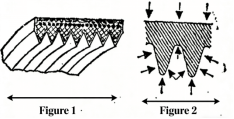
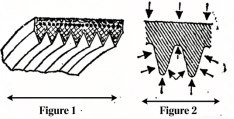
Multi-wedge belt A multi-wedge belt is a belt with a circular shape, with a number of longitudinal triangular wedges which are attached to a flat belt base (refer to Figure 1). It is made up of the wedge sides as its working surface, making it a new form of transmission belt. Having taken the merits of both types of belts, a flat and V-belt, along with their disadvantages, it has become more and more widespread in recent years.
I. Characteristics of Multi-V Belt Drives
1. Compared to conventional V-belt drives, multi-V belt drives offer the following advantages:
(1) Multi-v-belts are used to spread the pressure evenly through all the contacting surfaces by using the fluid incompressibility of rubber (see Figure 2). The level of contact efficiency on the wedge surface of the belt and the pulley groove is close to 100%. As a result, multi-v-belts, with the same width as that of the V-belts, can carry 30-50 percent more load than standard V-belts.
(2) A multi-v-belt because of its thinness can only have a minimum effective pulley diameter (demin) of a third or fifth the size of a normal V-belt pulley. Its structure is therefore less bulky and cost is lowered (demin values are indicated in Table 2).
(3) Multi-v-belt drives effectively avoid the limitations of multi-V-belt drives, including vibration, uneven loading and unstable transmission ratios due to changes in the belt length.
(4) Multi-V belts have low elongation and they do not creep when overloaded. There is minimum relative movement between the wedges and pulley grooves and thus less heat is generated by friction and lengthy life cycle of the belt and pulley working surfaces.
(5) Multi-V belts are very flexible and light-weight and therefore the power is not lost in bending and centrifugal forces during transmission hence the transmission efficiency is high.
2. They have the same flexibility as flat belt drives, which means that tension pulleys can be deployed on the inside or the outside of the multi-v-belt. They are, however, unlike flat belts, unable to come off the pulley whilst it is operational. They should be used in high-speed transmission and can reach the speed of 10,000 r/min, with the transmission ratio of 1:10.
3. Multi-v-belt pulleys are also easier to manufacture and machine as they do not require any special tools or equipments as is the case with synchronous belt drives. The installation requirements of installation are less than those of synchronous belts, making them easy to be adopted by many factories. Making the replacement of synchronous belts with multi-v-belt uses can be very cost-effective where mechanical transmission ratios allow tolerances as slight.
II. Introduction to Multi-V Belts and Pulley Systems
1. Multi-V Belt Models and Cross-Sectional Dimensions
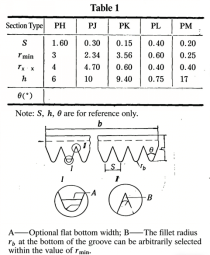
Multi-V belts are classified on the basis of material as rubber and polyurethane. Rubber V-ribbed belts V-ribbed belts have a greater heat and load bearing capacity than polyurethane varieties and are more commonly used. The rubber V-ribbed belts fall under the classification of PH according to ISO/DP9982-1988 as seen in Table 1. PH belts are mainly utilized in office machinery and instrumentation transmission, which is mainly used to transfer motion. PK belts have a definite purpose in an automotive application like the fan, alternator, and water pump drive. The use of PJ, PL, and PM belts is widely used in general industrial machinery transmission systems. The designation of multi-V belt in some countries like the United States and the United Kingdom incorporates: H, J, K, L, M with the basic belt size being very similar to that in Table 1. The most popular among them are the J and L types. Even though there are slight variations in dimensions of cross-sectional aspects of different countries, it does not hinder universal exchangeability among products. In the case of M-type multi-v belts, the angle of the wedge is similar in all countries, and its value is 40, but the distance between the wedges differs. As a result, M-type multi-v belts of various countries do not always work with each other.
The ISO marking of the belt consists of the wedge number, the type of cross-section of a belt and its effective length. As an illustration, a PM-type belt, consisting of 10 wedges and an effective length of 3550 mm is labeled 10PM3550, but in the United Kingdom and the United States is labeled 550M10.
Specialised equipment is used to measure the effective length (L) of the belt. Each belt model has specific values that it has with regard to the effective pulley diameter (d.) when measured. Of interest is the fact that the effective length (L) that is used by ISO in comparison with the terminology of pitch length (Pitch Length) that is used in countries like the UK and US actually refers to the same length. They both mean the circumference of the belt in the effective pulley diameter d. Identical standard series of pitch length have been established in the United Kingdom, the United States, and Japan and other countries, but not in ISO/DP9982.
2. Pulley Types and Cross-Sectional Dimensions
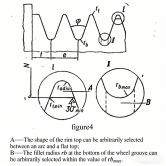
The multi-V-belt pulleys are categorized into five types based on ISO/DP9982, and their cross-sectional size is presented in Figure 4 and Table 2.
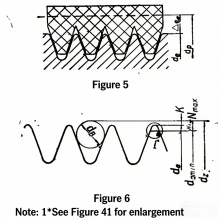
The outside diameter (da) of the pulley can be (as specified by ISO) equal or unequal to the effective diameter (d.). However, in other countries like UK, US, and Japan the pulley outside diameter (outside diameter) is fully comparable with the pitch diameter. It should be mentioned that the effective diameter, specified by ISO and the pitch diameter used in such countries as the UK and the US, are actually the same diameter. Both in terms of effective length of the belt or effective diameter, the exposition and specifications of them in ISO are strictly defined and precise. The reason is that the actual pitch diameter (dp) of a multi-v-belt pulley must lie in the neutral layer location of the belt subsequent to it being deployed on the pulley and properly tensed as shown in Figure 5.
Based on Figure 5 we can observe that the pitch diameter force of the pulley is calculated using the following equation:

Table 2 indicates the effective line difference △e in the formula.
The circumferential velocity (V) and transmission ratio (i) of the belt is mainly calculated based on the pitch circle diameter where the equation is:

Where: dp1 is the diameter of the small wheel pitch circle, in millimetres; n 1 is the rotational speed of the small wheel, in revolutions per minute.

In the equation: 1 and 2 refer to the small and large wheel respectively.
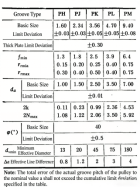
To avoid over bending stresses in the belt during transmission and to minimize the life of the belt, ISO has indicated the minimum effective diameter (dmln) of each type of belt as indicated in Table 2.
In machining, to regulate the depth of the groove in a multi-v-belt pulley, the outer diameter (d 2 ), of the measuring rod (or ball) wedged into the groove shall be determined as shown in Figure 6. The formula of calculation is: dz = d + 2K.
Where: k and dg of the measuring rod (ball), K and dg, are given in Table 2.
When the pulley is manufactured with da = d, then d₂ = da + 2K. The limit deviation for d₂ is ±0.13 mm.
III. Applications of Multi-V Belt Drives
Multi-V belt drives have been widely used in many industries in the foreign countries such as automotive, textile, chemical, defence, domestic appliances and office machinery. Multi-wedge belt drives will be most appropriate in replacing V-belt drives in equipment that has many V-belts and can receive much impact load. These include rags, waste yarn and shoe upper fabrics waste-cutting machinery; heavy-duty textile machinery and piston pumps. Moreover, in transmissions where the axis of the wheel-shaft is perpendicular to the ground or semi-cross, a change of V-belt or flat-belt drives to multi-v-belt drives has exceptionally strong benefits.
The operational parameters for multi-v-belt drives are broadly: rotational speed n₁ = 200–10,000 r/min; power P₁ = approximately 0.2 kW to 300 kW; transmission ratio i ≤ 10; transmission efficiency approaches that of flat belts, n ≈ 0.97.
The multi-v-belt drives have created a lot of headaches when it comes to the developmental prospects of the same in China. The replacement of many ageing multi-v-belts of imported equipment is a particularly burning problem. Not only would local manufacture of conforming multi-v-belts save the country a large amount of foreign exchange but also help in the universal use of the new belt drive technology in various industries. This would actively facilitate the growth and development of the belt manufacturing industry in China.