 EN
EN
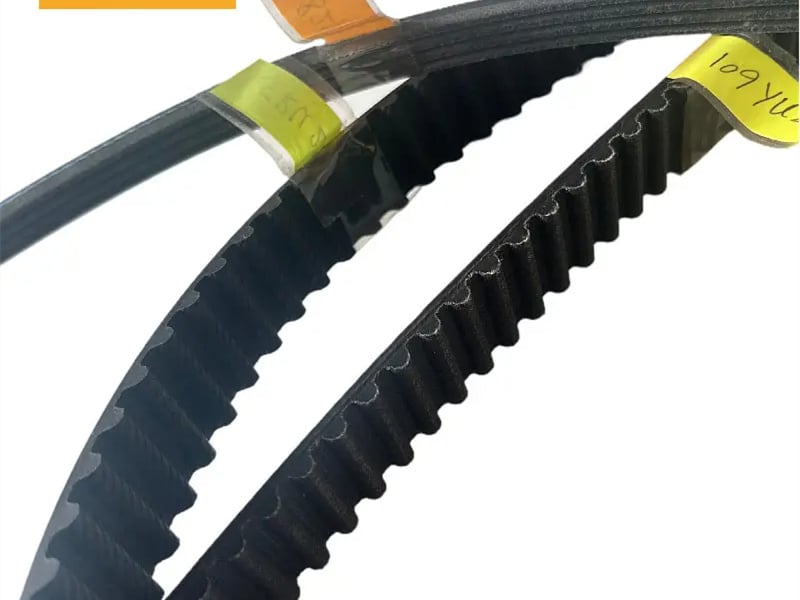
Belt slippage in automotive drive systems can cause squealing, loss of power steering, overheating and even engine stalling. Slipping occurs when there is insufficient friction between the driving and driven pulleys, resulting in a loss of engine speed. Repeated belt failures can hurt fleet operators’ bottom lines. With over 26 years with many years of experience in designing and manufacturing V-belts, PK belts, and timing belts, Guanpin experts have extensively studied the cause of belt slip and have effectively addressed them in our production process. Today let's list the main four reasons for the belts slippage.
Incorrect Belt Tension – The Most Overlooked Culprit
Slipping normally starts by using an incorrect installation tension. If too slack it can’t grip the pulleys correctly. If too tight it can stretch the cord prematurely causing future slack. Some workshops will use the “push with the thumb“ technique which is very subjective. Here at Guanpin we engineer all our belts to have a designed static tension range, calculated for the pulley pitch and center distance, measured using frequency meter or a deflection gauge. Crucially we utilize, and carefully engineer low-elongation polyester or aramid cords which retain set over thousands of cycles as the product goes through its thermal cycles. All our timing belts undergo tension decay testing at 100°C for 200 hours. If any batch loses more than 2% tension, our team adjusts the cord dip treatment accordingly. For long-term fixes for these applications our customers can use automatic tensioners or spring-loaded idlers. Fitting charts are included with all bulk shipments. A correctly fitted Guanpin belt will perform reliably without slipping.
Pulley Wear, Misalignment, and Contamination
Belt slipping will occur even with a new belt if the pulley surfaces are polished, worn, or misaligned. Pulley wear reduces the coefficient of friction, while angular misalignment causes the belt to run on the edge of the pulley, significantly reducing contact area. Contamination from coolant, oil or dirt and more also reduces the effective coefficient. The Guanpin permanent answer starts with a careful choice of material, a Guanpin EPDM based composite is formulated with excellent friction coefficients of ≥0.5 on steel and is treated to be oil and coolant repellent. We also produce PK style belts with micro ribbed undersides that help purge surface contamination. Nevertheless we make a point to ask our customers to check their pulleys when they replace belts, and we include a complimentary pulley wear gauge and pulley alignment checklist for any samples that we receive in which scoring and /or eccentricity has occurred. Where this happens in our test samples we always recommend new pulleys on new belt applications so that slip starts at nil
Excessive Load or Shock Torque – When Design Margin Matters
It isn’t always a symptom of a faulty belt; often it’s because the additional accessory load – whether it's your alternator, A/C compressor or water pump – can demand more torque than the belt itself has the capability to transfer. This occurs more and more with the integration of additional electrical and hydraulic demands to a vehicle's factory specifications. That’s why Guanpin supplies cord options that suit the demands of your unique application, such as polyester for typical passenger cars, aramids for heavier truck loads and even glass fiber for timing belts that may require additional durability due to reverse crankshaft shock loads. We can provide the data, (including required cord tensile modulus and rib geometry) that tells you how to properly select a cord capable of tolerating torque shock loads and prevent micro-cracking that leads to slippage. We are able to produce “high-grip” versions with a specialized surface treatment that increase friction by 15% without adversely affecting dynamic performance. Load-capacity charts are provided with all our series to ensure that customers never have to guess or under-specify.
Ageing, Hardening, and Loss of Elasticity
Belts inevitably age, over time the friction, heat, and air exposure will harden the compound, which limits its ability to mold itself into the contours of a pulley or engage properly with timing belts. The Guanpin difference Our proprietary, patent pending anti-ageing package will keep the belt young for its useful life. Our EPDM and CR compounds, reinforced with innovative antioxidants, antiozonants, guarantee retaining 90% of the original elasticity after 1,000 hours of 120°C oven ageing. Our advanced, yet novel curing process gives us optimum cross-link density for both flexibility and abrasion resistant characteristics. The timing belts employ a wrap-cut abrasion resistant fabric layer for positive tooth wear resistance and stability of dimensions through 150,000 miles of service. It’s more than a belt- it’s an investment in durability and longevity, backed by batch aging tests that prove our claims.
We do not consider slippage to be the natural order of things. Slippage is a problem and as an engineering issue, it can be solved. For the past 26 years since we started out as Huayu Rubber Belt Factory, we have understood that if the slippage is to be eliminated on a permanent basis then that problem can only be solved if attention is paid to tension, pulleys, loading and material in synergy. We do not just sell belts, we provide free consultation, installation manuals, and torque calculators. If needed, we can also customize the compound to eliminate vibration-induced slip. With a Guanpin belt installed, rest assured that your drive system will perform efficiently and stably, mile after mile.