 EN
EN
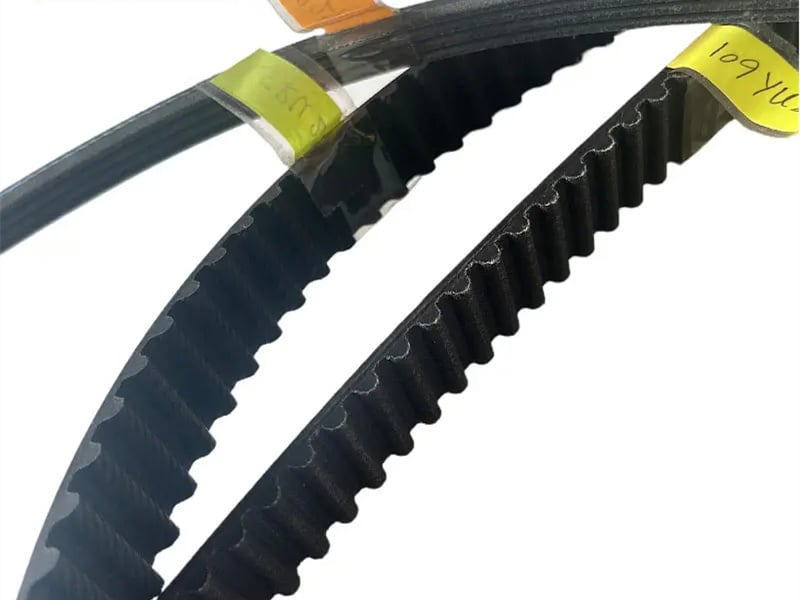
The timing belt, V belt or PK belt (all types of belt) has a service life that is not chosen at random, but carefully engineered by selection of the belt material. The rubber compound and tensile cord play the most important roles in the properties of durability, fatigue resistance, and dimensional stability. Experience has shown that altering the polymer chemistry of a belt, or the treatment of the cords can double or half the life of the belt. This article focuses on the direct link between rubber/cord material and belt performance and how we customise materials to meet specific operating environments to the client's requirements.
Rubber Compounds Thermal Stability and Wear Resistance
The rubber matrix is the first line of defense when it comes to protecting against the under-hood aggressors like heat, oil, ozone and abrasive debris. Neoprene (polychloroprene) is an older material that has proven to be effective for engines for years, but there is a need for improved performance in today's engines. Our car belts are mainly made of EPDM (ethylene-propylene-diene monomer), which has excellent ozone/weathering resistance and a high degree of heat resistance (150°C continuous). EPDM also is still flexible at very low temperatures, thus minimizing cracking during cold start. But not all EPDM compounds are the same, however. The molecular weight, ethylene/propylene ratio and diene content can influence cure rate and tear strength. We use a carefully balanced blend of carbon black and silica fillers which we have carefully balanced for maximum abrasion resistance, while maintaining dynamic flexibility. The hardness (Shore A) and hysteresis properties can also be controlled to minimize the internal heat generation under cyclic loading, which is a major contributor to premature belt failure, particularly in heavy duty and high torque applications.
Tensile Cords Preventing Stretch and Fatigue Failure
The rubber provides traction and protection and the tensile cord absorbs the pulling force. A cord when stretched beyond the limit snaps out of its tension and slides; when a cord is fatigued, it snaps catastrophically. Guanpin provides three types of cords which are polyester, aramid and fiberglass. Polyester cords make a reasonable compromise in strength, low cost and moderate elongation and will serve for regular V-belts and fan belts. Aramid cords (also Kevlar-type) have a very low creep index and a very high tensile strength and are good for severe duty timing belt and for the use in the PK belts in the turbocharged diesel engine where shocks on the belt occur regularly. The high precision timing belt is used in the field where the accuracy of the valve timing is the key, near-zero elongation fiberglass cords are used in the belt. The type of fibre, the twist and the type of dip adhesion treatment and post dip stabilisation process also have a very important role to play. Proprietary RFL (resorcinol-formaldehyde-latex) dip systems are used for complete bonding of cord and rubber, eliminating the “pull-out” that is found in many less-than-satisfactory belts at high speeds.
Synergy Between Rubber and Cord Dynamic Load Distribution
A belt is not a rubber block that has a cord inside, it's a composite belt with material interface, which will determine the strength of a belt. During bending through pulleys different moduli (stiffness) of the rubber and cord cause internal shear stresses. These stresses over time lead to separation or cord fatigue. Guanpin engineers use the finite element analysis (FEA) to ensure that the curve of tension-elongation of the cord is in line with the rubber dynamic modulus in the working temperature range. For example, since a timing belt with glass fibers is required to have little flexural heat at the belt's tooth root, it must use a hard rubber with a low hysteresis. On the other hand, a polyester cord V-belt can have a softer rubber, which will absorb impact loads from accessory clutches. Also we re-align the path of the cord as it is wound (spiral or straight-laid) to ensure that all the filaments are equally loaded. This synergy helps our belts to last thousands of hours without re-tensioning, leading to longer belt life.
Environmental Factors and Custom Material Solutions at Guanpin
Other factors also have a significant impact on the service life. These include such items as operating temperature, exposure of engine oils, belt speed and misalignment of pulleys. In the desert and arctic regions a 100,000 km rating in the temperate regions could be reduced to 50,000 km. Guanpin offers full material customisation based on the understanding. To increase the heat life, antioxidants and heat stabilizers are added, and also the cross-link density of the EPDM is increased. In addition, in environments that contain oil it is possible to make a nitrile rubber compound that is oil resistant (typical for some older engines that have a leaking oil seal). In humid climate or coastal regions materials are formulated with the object to reduce hydrolysis (moisture degradation). Colors can also be customized not only for visual appeal, but for ease of maintenance personnel identification for various rubber hardness grades for proper maintenance of that specific rubber. Tests are conducted in our in-house laboratory on each lot of raw rubber and cording before it is produced, to determine the heat, ozone, fatigue and tension retention when the rubber is aged with the cording using accelerated aging methods. Working with Guanpin, you are not receiving a generic belt, you are receiving a custom solution based on our 26 years of knowledge in material science, developed to give you the maximum service life in your particular application. We are happy to accept conditions of operation from all over the world and will recommend and supply the best rubber/cord combination to meet the requirements. Join us, and experience the Guanpin difference in every mile.