 EN
EN
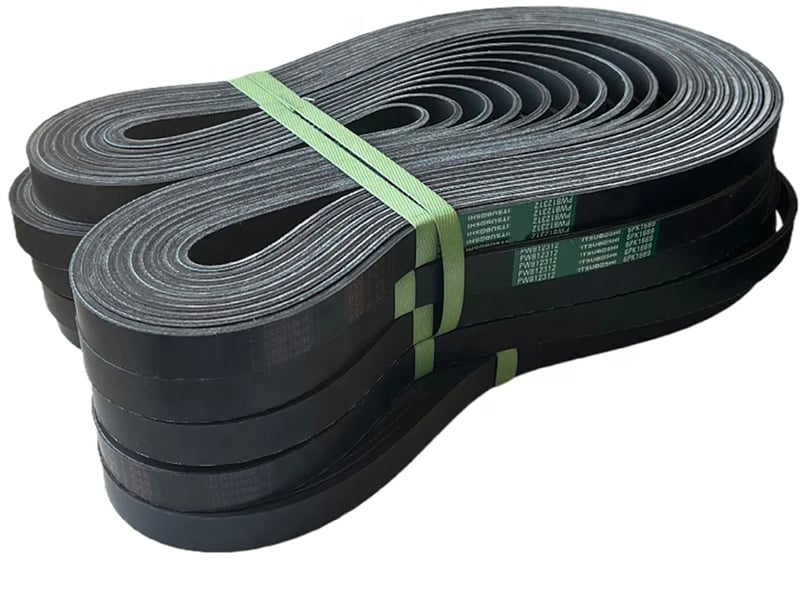
Whether you own a repair shop, manage a company fleet, or supply auto parts, choosing between standard original equipment (OEM) belts or more generically branded aftermarket replacements is no easy decision. At Guanpin, with more than 26 years of expertise designing and manufacturing OEM-standard V-belts, timing belts, and fan belts, we have seen products that fall in both extremes. Some aftermarket belts give out long before they should, but high-quality, properly manufactured, OEM-standard alternatives are available that function every bit as well – and at times better – than their manufactured origin counterparts.
Material Composition and Compound Consistency
OEM-standard belts are made with meticulously tested rubber compounds equivalent to what your car manufacturer specified. Guanpin’s OEM-spec program uses EPDM and top-grade chloroprene with exacting carbon-black loading, anti-degradants and curing systems. They are certified lot by lot to all applicable tensile, elongation, hardness and heat-aging specifications. Low-cost, no-name aftermarket belts generally consist of all-purpose generic compounds with minimal polymer content and substantial fillers. While they may look the same on the dealer's shelf, heat cycling in the field drastically separates the two. We've tested belts in real-world heat conditions. Some aftermarket belts softened and lost up to 40% of their original tensile strength within 100 hours at 100°C, while our OEM-specific compounds showed no similar loss. The result is a visually indistinguishable part that behaves very differently on the dyno.
Dimensional Precision and Pulley Fit
OEM belts are specified with precision down to the millimeter for belt length, and the hundredths of a millimeter for tooth pitch (timing belts), rib spacing (PK belts), and sidewall angles (V-belts). This level of precision ensures proper assembly and operation. Guanpin's OEM-standard manufacturing lines combine precision ground tooling with laser measurement to bring you every belt to within ±0.5mm of the specified length and ±0.05mm of the tooth pitch. The net result is a belt that properly fits into your pulley grooves without slipping, causing wear or creating noise. Too often, in an attempt to minimize scrap costs, aftermarket manufacturers have looser tolerances. An extra 2mm of belt length on a timing belt may seem trivial, it will still fit, but it can throw off cam timing and tensioner pre-loading to the point of rough idling. In the case of a catastrophic mismatch, even piston-to-valve impact. Buy belts that meet the OEM standard. Anything less is a compromise.
Tensile Cord Strength and Fatigue Resistance
Each and every vehicle belt is built around a tensile cord-made from glass fiber, polyester or aramid fiber. OEM class belts are formulated with the cord at the heart-treated with adhesion promoters and strategically laid helically within the belt construction. Guanpin chooses materials based on the application: glass for conventional timing belts, aramid fiber for high output diesel applications, and polyester for serpentine accessory drives. When completed, our OEM quality belts are put through rigorous cyclic life test conditions under tension at engine operating speeds for hundreds of hours. We consistently demonstrate over 90% retention of tensile strength after 300 hours. Poor value belts generally exhibit inferior cords either untwisted or improperly adhered and can result in immediate and unexpected belt separation and failure with little or no prior indication, especially problematic in timing belt applications where belt failure translates to engine damage.
Quality Control, Traceability, and Customization
Guanpin’s OEM-production quality is trusted by OEMs worldwide. We rely on a closed-loop quality system that tracks belts from raw material to the end application. Each belt is equipped with a batch code identifying its production run, raw material certificates, curing records, test results, and all traceable elements required for a warranty or technical call. Our QC includes 100% visual and dimensional checks as well as a per-lot destructive sample test. OEM-production does not equate to inflexible specifications. We offer OEM logo application, custom packaging, unique rubber colors, alternative cord options, or custom cord diameters-with the same strict QC controls. Generic aftermarket belt manufacturers don’t offer traceability. Once their belts pass final QC and leave the factory, there’s no way to verify their origins or construction. For an OEM wanting to establish its brand trust, this ambiguity represents a significant risk, which Guanpin solves.
There's no need for "aftermarket" to equal “inferior." Guanpin OEM quality belts are manufactured to provide the same fit, form and function as original belts-for all Asian, European, and American made cars. Challenge your local belt supplier to present you with a lower price alternative, and compare ours with theirs, eye for eye. The result is the same; engine efficiency, and an excellent reputation. Call us to request samples, custom imprints and discuss your specific application, based on 26 years experience making belts work.